04 August 2007

A feminist book for all of us

I sent out the announcement that I'd reviewed a moderately interesting mystery last night. Today, Dan Conrad comes through with his reaction to what sounds like a much more meaningful experience. His praise for this book is extraordinary. It's now on my list of books I really must read. I bet Kris' book group and Nancy and her friends would be attracted to it as well.

Dan wrote:

Just last night I reluctantly came to the end of Hanna's Daughters by a Swedish writer, Marianne Fredriksson [at right].

One thought was "now, who could I really recommend this to?" Then I got your e-mail and thought, well, maybe Nancy or Kris, for example.

The novel tells the story of three women, a grandmother, a mother and a daughter.

They are not caught up in some international intrigue nor are they pursued by a serial killer. What they are caught up in is just getting on in life and trying to understand one another, and themselves, and the changing times (and their changing selves)--and the effect they have on one another, the mystery of love and the pull of obligation.

When I finished, I just sat there for a long time feeling I had not just read an absorbing story, not just come to know three characters well and from the inside, but had a deeper understanding of humanness itself. It may have helped that it takes place in Sweden and that reading about the grandmother gave me some insight into my own great grandmother who was born in Sweden in 1827 into a life of hardship until she came to America in 1893, old and tired, but not broken.

But then, the novel has also been popular in places like Germany, Korea, Israel, etc. so it hits, I think, on more universal themes. One of which the author mentions in an afterward in saying one of her goals was to "investigate why women in our western society aren't able to help themselves to the rights they have received."

Maybe a lot of us, male and female, get less from life than we could, or that we deserve.

Anyway, just passing this on. Not for everyone, no doubt, but for me it is one of the more absorbing and thought-provoking--and wise--books I've read in some time.


03 August 2007

A P. D. James mystery

One day when meeting Jo after lunch, I started reading a P. D. James [at right below] mystery from the library at Village on the Cannon. It took awhile, but I read little bits and pieces, and by about half way through, I wanted to finish it.

The book was Original Sin. (That's a clue, folks, but one of the few you'll get while reading the book. And if you insist on taking it theologically, the clue won't help much.)

Adam Dalgleish [Roy Marsden as Dalgleish below left] is James' star, but while he's obviously the brains of the outfit, he's not on stage as much as his assistants. As a reviewer at the Bastulli Mystery Library says, "...unlike most series, James seems to use her main character just for the needs of the story and not vice versa."

First assistant Kate Miskin and second assistant Daniel Aaron do a lot of the leg work and interviewing, although the master steps in at crucial moments to get the truth from recalcitrant withnesses, resolve conflicts of poorly-skilled parents, or figure out the crucial meaning of ambiguous clues.

James writes extended internal dialogues (even for minor, irrelevant characters) and detailed descriptions of how people travel around London. There are some lectures about the history and character of London's Thames those who live near it. I tried to compare these long-winded descriptions to the romantic word pictures that Tony Hillerman paints of the desert, but I just never got beyond long-winded. Maybe if I was a Londoner who shared James' feelings that living within sight of the Thames in London was epitome of residential achievement, I would have had more patience.

Okay, the story is moderately interesting and complex. A small, 200-year-old publishing company is the center of a suicide and two suspicious deaths that might have been murders.

Most of the characters are well-drawn and the internal monologues do make most of them more than cut outs on a stage.

It's a mystery that you won't figure out until the very end, but that's partly because there is so much detail and so many clues and so many gaps in the details. Perhaps that realistic, but if you enjoy saying "Aha!" about two-thirds of the way through a mystery, you won't get that until the last couple action-pacted chapters.

I don't know whether this is a recommendation or a warning. You'll have to decide for yourself.

Not long after I wrote this, Dan Conrad e-mailed this question. If you have an answer, add it as a comment below or send it to me using this link:

"I read Original Sin several years ago after someone told me P.D. James was absolutely incomparable as a mystery writer. I thought it was pretty good, but not more than that. I next tried Devices and Desires and had the same reaction, and haven't bothered to read another. Is there someone out there who can say: 'these are the one or two best P.D. James novels?' I still think I might be missing something."

Write. Tell a little bit of the world what you think.


16 July 2007

Jon Katz on people and other animals

When we began coming to the little lake cabin called Sidetrack a decade ago, Nancy and I got library cards at the Amery, Wisconsin public library.


Amery, 16 miles mostly south of Sidetrack, is about three times the size of Lake Wobegon and has a great public library. The library is well-supported by its public and run by people who love reading. There are always great new books inside the front door, and the rest of the place is packed to the rafters with books. Every window in the building has become the frame for added bookshelves. And the librarians are gracious enough to offer library cards to us summer people.

We got into the habit of stopping in Amery Fridays for groceries, pop, beer, and books on our way to Sidetrack. On Sunday, our ride home included a stop in the library parking lot to drop books into the return slot.

It's mid-July and only my second trip to Sidetrack this summer, but I remembered to stop for a book in Amery.

What I found was Jon Katz's latest book, Dog Days, Dispatches from Bedlam Farm. I enjoyed a couple of Katz's mysteries long ago, and I really liked his "middle age crisis" account of buying a mountain top retreat, Running to the Mountain. Since then, it seems, he's been writing mostly about his dogs.

Katz is a keen observer and a good story teller. He's also worked hard at learning how to have good relationships with his dogs and other critters.

He has left his mountian retreat for a farm in upstate New York. He makes a living writing and teaching. I can't figure out how he has time. Bedlam Farm is home to named animals, like his dogs, donkeys, and cows. The farm is also home to numbered livestock, the sheep. Katz is also overseeing the restoration of the old house and barns on the farm.

I liked Katz's stories, but I liked his stories about people better than his stories about animals. His stories about Rose and Izzy the border collies are a close second to those about "grunt and grumble" sessions, Annie, the goddess of Bedlam Farm, Adelaide, and the "Quiet Group." The people stories reminded me of what I liked best about Running to the Mountain.

Unlike Chip and Jon Katz, I'm not an animal person. I can't imagine wanting to expend the effort and emotional energy to maintain and tend the animals on Bedlam Farm that Katz describes as normal. There aren't many people I can imagine who would ungrudgingly get that kind of effort and attention from me. (Luckily, I can think of several people who fit into that category.) So most of the animal stories left me shaking my head and unable to understand the rewards of scratcing donkey noses, being licked awake by a large smelly dog, or mucking out a barn after a rainy spell.

If you're an "animal person," you'll probably like these stories a lot. And if, like me, you're not an "animal person," you might still like this book. The people stories are great. Give it a shot. The book is brand new, but even the Amery library has a copy.

Tell us what you think of the book. (See the "comment" link below? That's what you click on in order to add your comments to mine.)


Murder in Yellowstone's "free fire" zone

Book giver Mary dropped off another mystery by C. J. Box on her last visit. This one is Free Fire, and we have personal connections to the setting of this one.

Box's latest is set in Yellowstone National Park and West Yellowstone, Montana. The connections are long term. The sisters A slept through the ginormous 1959 Yellowstone earthquake -- in a tent and a camping trailer. Grand Dame Jo and grandpa Steve had a summer home just outside of West Yellowstone. We visited frequently -- once in mid-winter. We feel like we know the Park (or parts of it) pretty well. (We could direct you to a real hotspot for cutthroat trout on Yellowstone Lake or an unpublicized swimming hole on the Firehole River if you're interested.)

I liked this story better than the last one Out of Range. There is less forboding in Free Fire and more story telling. There are some geology and history lessons, but they do help tell the story. If anything, there should be more story telling. Sometimes the story seems to move faster than the telling.

Besides the Park and glimpses of little West Yellowstone, features of this story include bioharvesting, corrupt officials, con men, an amoral West Yellowstone lawyer, and people in the wrong places at the wrong times. Game warden Joe Pickett, the star of seven mysteries, manages to be present at the destruction of another Wyoming state vehicle (it's become a recurring story element). It should be noted that this time, an earthquake did in the GMC Yukon.

In spite of his penchant for being in the proximity of the wrecking of government vehicles, Joe Pickett must be one of the world's cleverest men. He never misses a clue or an implication.

He's also one of the most persuasive people around. Whether he's getting FBI cooperation, access to the locked and winterized Old Faithful Inn, or a larger cabin for his family visiting at Mammoth Hot Springs, it seems that no one turns him down. Oh, except for the governor of Wyoming, who in this book is a maverick Democrat and not one of Dick Cheney's henchmen.

It was a great book to read while sitting on the deck at Sidetrack. Now the book goes on to Williston Jane, who has worked in the Park for the past several summers. You can find yourself a copy in the library or your friendly neighborhood bookstore or the link to Amazon.com below.

Thanks, Mary.


05 July 2007

Hillerman successors

For the past 30 years, Tony Hillerman has been writing mysteries set in Navajo country at the rate of one every 2 or 3 years. To me it seems like he invented a popular genre featuring Native Americans as crime solvers. Other people have followed his example. Margaret Coel is the one I'm most familiar with.

Hillerman is 82 years old. His most recent book, The Shape Shifter, could well be his last. Becoming his successor as a "mystery writer of the Navajo" would be a big deal. Even being a Hillerman imitator could be something to brag about.

At the Northfield library recently, I saw a couple paperbacks in the mystery section by Aimée and David Thurlo. I picked up Red Mesa and brought it home. Like Hillerman's mysteries, this one is set in Dinétah (the Navajo reservation) and tells stories around a Navajo police officer.

The Thurlos, like Hillerman, are knowledgeable outsiders in Dinétah. They've created a good mystery story. But their telling of the story is not up to Hillerman standards. Special Investigator Ella Clah, headquarted at the Shiprock station of the Navajo police, is a single mother who had significant experiences in the Anglo world before returning home. It's probably not a fair comparison based on a single book, but Ella Clah is not as compelling a character to me as either Joe Leaphorn or Jim Chee.


The majesty of desert and mesa that Hillerman writes about with such passion is missing from this book completely. The Thurlos' story telling is sporadic: sometimes moving too slowly for me; other times jumping ahead leaving gaps in my understanding.

That characteristic shows up in the writing in other ways. Characters sometimes offer a lot more explanation than they would in a real conversation and at other times they seem to leave out important details. I don't need to be told, for instance, that as a suspended police officer drives off from home that her white pick-up only gets used for personal trips.

On the other hand, it would be nice to know where that police officer, who was on the job all day, heard the gossip about her family that is central to her internal dialogue at the end of the day.

In other words, this was a dissatisfying book for me. I was hoping to visit Hillerman-land with huge skies, stark beauty, stormy male rains, and reflective attempts to harmonize the old and the new in the course of resolving a mysterious and dangerous set of circumstances.

What I read in Red Mesa was a patchwork story about politics, clan rivalries, irrational, murderous revenge, and magic intuition full of unexplained developments, sinister unidentified forces, and hard to accept rapidly-changing loyalties. In some ways that might be more realistic than Hillerman's romantic vision. But the realism isn't matched by the narrative.

Next time I go to the library, I won't pick up another of the Thurlo's novels.


29 May 2007

A pair to bet on

I've liked most of the Dana Stabenow's mystery novels that I've read. She's written 18 of them, all set in Alaska. Part of the attraction to me has been that exotic locale.

(I was, after all, a fanatic fan of Northen Exposure. I'd gotten over the Alaska thing when Men in Trees came along, but then neither was actually filmed in the great north.)

Stabenow has demonstrated to me really good story telling. She's also done humor very well in one of her novels and action/adventure very well in a couple others.

The family banking exec, my sister-in-law Mary, passed on two Stabenow books this spring. I just finished the second one and figured this is a good time to say something about them.

The first book is A Deeper Sleep. This is, for Stabenow, a run-of-the-mill story about Kate Shugak, an Alaskan native-American, educated in the outside and trying to reintegrate herself into what the community of her birth has become. The story also involves state trooper Jim Chopin, who at the time of this story, is Shugak's lover. (There's a lot of interesting back story from more than a dozen earlier novels, but it's not necessary to have read them to enjoy this one.)

The little rural community and the characters in it work for me. I grew up in a small (not as small as Niniltna, Alaska) Minnesota town, and the portrayal seems realistic. Most often in these novels, Stabenow brings in outsiders as hunters, tourists, or run aways, as bad guys or victims. This time around it's the locals who are bad guys and victims.

The tale is complex and kept me interested and guessing right up to the end. It was an enjoyable escape for the hours I read. If you haven't read any of Stabenow's mysteries, it's one you could start with. If you liked it, you could find earlier ones in the library or used book shop.


The other book Mary dropped off for us was not typical of Stabenow's novels. It's a covert weapons trade/terrorist/CIA/FBI/Coast Guard/romance. It's called Blindfold Game, and is perhaps Stabenow's attempt to break out of the mystery genre. (Her first three books were science fiction, but then she won an Edgar for her first Kate Shugak mystery.)


As a thriller/adventure story it also follows up on a couple Kate Shugak novel that were action-packed. Blindfold Game involves arms dealers in Switzerland, North Korean terrorists, a dirty bomb on a surplus Russian missile, tramp freighters, a CIA desk agent and his Coast Guard officer wife, an Alaskan FBI agent, and a Greenpeace ship.

It's a well-told story with at least two-dimensional characters. It's intriguing enough to tempt me to learn more about the arms trade and itinerant shipping. I got close to the end one evening before bed and I knew I couldn't read the ending and expect to sleep. So the book sat on the pile for several days before I finished it one early evening. Luckily I had a couple hours to let my heart stop pounding and my blood pressure to go back to normal before I wanted to sleep.

Yes, I thought it was good. It was published in January 2006, so the paperback might be on bookstore shelves now. A Deeper Sleep was published in January 2007, so look in the library for it.

These were great spring reading. They might be great summer reading too. Read one or both and add your comment to mine.


22 May 2007

Old entry from the old site

From ReadingOnTheWeb, the predecessor to this blog. I add this here, because, Mosley's book is one of the best ones I've read in years.

Written 15 November 2002:

I had a 28-hour trip to Detroit recently.

I picked up a Walter Mosley book I'd heard of a few years ago.

Always Outnumbered, Always Outgunned was reviewed favorably, but there was something about the comments in those reviews that put me off at the time even though I have generally liked Mosley's books very much.

It's not really a novel.

The book is a collection of stories that amount to an extended character sketch of Socrates Fortlow, a middle-aged man who spent half his life in prison. The stories are set in mid-1990s Watts, and Fortlow (like his ancient namesake) is in search of virtue and self-knowledge. The stories describe his gradually greater involvement with the community and his efforts to make his life count for something good.

Fortlow's conversation with an old couple who ran a bookstore in a nearly abandoned Watts strip mall is a significant glimpse of the book. Fortlow speaks first:

"They let me go 'cause all I did was kill black folks. They don't think that black folks are worth a whole life in a white man's jail. But I wasn't cured. I was still mean an' still confused. You know my main problem was that I was never sure what was right. You know--absolutely sure."

The Minettes both stared. Socrates was certain that they weren't afraid of him.

"But you did change?" Oscar Minette asked.

"Comin' down to your store. Listenin'...An' watchin' you two just sit back and lettin' it all happen. It was like I was seein' through your eyes. I'd let my mind be smilin' an' carin' 'bout people when I knew that they was wrong. Somehow watchin' you made me see myself. You know what I mean?"

"You're a good man, Mr. Fortlow..."

"Why you say that, Oscar?"

"Because you know...that there's something good in the world...and you want it."

"What good is this you talkin' 'bout?"

"Purpose, Mr. Fortlow. Purpose. We're all here for a reason. There's a divine plan. Good men want to find their place in the plan. That's you."


The book is full of such ruminations and the actions that Socrates Fortlow takes in his attempts to find good and be good.

This is an inspiriting book. It's a thoughtful book and I highly recommend it. It's in the library. It's on the bookstore shelves. Find it and read it.


  • John Chutterbuck's review in the Houston Chronicle

  • An admiring review from Herbert Huber in Germany (auf Deutsch)

  • An interview with Mosley about Socrates Fortlow as part of a reading group guide

  • A review from MostlyFiction.com


After reading Walter Mosley's book, Always Outnumbered, Always Outgunned, I left it on Dan Conrad's dining room table because I thought he'd like it at least as much as I did. Here's what he wrote about it:

"I'm almost finished with the Mosley book. I began reading it on the heels of Jane Austin and at first the shift in style and lifestyle was almost too much.

"I plunged on, spurred by your recommendation and was soon completely caught up in it. What wonderful characters and characterizations. I found myself following my teenaged son, Jeremy around reading parts to him -- whether he liked it or not! Wisdom and writing excellence come in many guises! Thank you so much."


You're very welcome, and thank you, Dan.

Based on the results of passing books on to Jana Eaton, Carrie Lucking, and Dan, I guess I should try giving away more books.


15 May 2007

Romantic science fiction

Many years ago I read a science fiction novel by John Varley, and was impressed enough to remember his name. I think the book was Titan. But I'm not sure. When I looked up the plot summary, it didn't sound like the book I remembered at all.

The reason for looking up Titan was that Nancy brought a John Varley book home from the library. This one was Red Lightning. Like Titan, this book involves the conflicts between residents of two different worlds.

In Red Lightning, the two worlds are earth and earth's fairly independent colony on Mars. The Martian colony and earth's survival are dependent upon the discovery/invention of a nearly-unlimited, non-polluting source of power controlled by a benevolent scientist. (Like most science fiction, this requires major suspension of disbelief.)

The separation between the two "worlds" is complete enough and old enough that culturally the two places are rather different. Rather like England and its American colonies in the late 1700s were different, I suspect (and I suspect that Varley intended that comparison).

So, politically and militarily, the power held by the scientist is too attractive. Many people wanted to run things. The scientist disappears and takes his secrets with him. The scientists' relatives live in Mars' rather idyllic society. The powers that be on earth invade Mars. The "Martians" rescue the scientist, find ways of resisting the earthlings' invasion because the scientist demonstrates that his power source is not only benign, but lethal. And the Martians live happily every after.

It's a romantic fairy tale in many ways. It's a hippie manifesto. (Varley spent some of his teenage years on the streets of Haight and Ashbury.) It's pretty well written and the story is well told. It was just the kind of escapism I needed last week.

If it sounds attractive, check it out. Your library may also have a copy.


08 April 2007

Just the facts, ma'am. Just the facts.

J. A. Jance has written more than 30 books. Most of them mysteries. There are 17 about a retired detective, J. P. Beaumont, a dozen about Sheriff Joanna Brady, and now two about Ali Reynolds, an LA TV news reader who was unjustly fired for being too old. That means, evidently, that Ali Reynolds is rolling in lawsuit settlement money and has nothing better to do than get involved in murder mysteries.

Mary Ashmore kindly passed to us Web of Evil, the most recent of the Ali Reynolds books.

This is a good story. There are twists and turns here to keep characters hopping and this reader interested.

The story and the characters are not part of real life, because there are murders, a crime family, drug running, an undercover DEA investigation, a friend who happens to be a police detective with friends in high enough places to get inside information, and people with more money than god. But, in spite of all that, the story and the characters are mostly believable. Well, there is a bit of instantaneous high tech that reminded me of the seemingly cost-free DNA tests that are done within hours on the CSI-type TV shows, but things are mostly believable.

Jance is a good story teller. I've liked nearly all of the Joanna Brady books I've read. (I think I've read only one of the J. P. Beaumont books, but I don't remember anything about it just now.)

I was ready to shut the book having finished the narrative when I notice that there were still a whole bunch of pages unread. "What's this?" I asked.

The bonus in this book is that once the main story has been told, Jance adds two-and-a-half post-climax short stories to the book. One of them is very good.

Jance's books aren't as meaty as those of the Scandanavian writers* from Jance's generation that Dan Conrad and I discussed earlier, but Web of Evil was a good book to read while sitting on the deck overlooking the Gulf of Mexico at the end of March.

Thanks, Mary.


*See


03 April 2007

Light Weight Reading

Kris gave her little brother David a book, and I read it first. David was a little busy with Japanese, philosophy, calculus, and other academic things.

The cover of Jasper Fforde's book The Eyre Affair quotes a Wall Street Journal review saying that the book “combines elements of Monty Python, Harry Potter, Stephen Hawking, and Buffy the Vampire Slayer…” As Dan Conrad demonstrated on these pages once some time ago, we all should be suspicious of excerpts from reviews, but in this case the excerpt is an understatement. Fforde's book also contains elements of Saturday Night Live, Xena, Warrior Princess, The Simpsons, Star Trek, Sherlock Holmes, Pee Wee's Playhouse, and even a bit of Twilight Zone. And then there's a passel of bad “near-puns.”

I keep saying that I don't like improbabilities. Everything in this book is improbable. And I still was entertained. The main character is Thursday Next. The New York Times reviewer said she's “part Bridget Jones, part Nancy Drew, and part Dirty Harry.” You should now have the idea that Fforde's inspirations are improbable too.

It's set in Great Britain in the 1980s, but it's a 1980s where no one has invented airplanes or computers. Literature is secularly sacred, and people travel into books and poems. People also travel through time. But if a literary or time traveler messes with written art, the penalties are severe. Thursday Next is a literary detective, hunting down forgers and people who change novels because they don't like the original endings.

Thursday's assignment in Fforde's novel is to track down a villain who kidnapped Jane Eyre from the Bronte novel. What did I tell you about improbable? How about trapping the bad guy in Poe's The Raven? Well, there is Thursday's pet dodo bird. It, like all the other pet dodos in Great Britain were cloned from salvaged DNA. Oh, and in Fforde's world, Wales is an independent kingdom that guards its borders with England fiercely. That last part is just dreaming on the part of Welshman Fforde.

The Eyre Affair was enjoyable enough that I bought Fforde's second book when I found it on the overstock table at River City Books. Lost in a Good Book continues where The Eyre Affair left off. But now, Thursday Next's husband has been kidnapped into a book somewhere and the bad guys want their hero out of The Raven. Detective Next journeys into Great Expectations and becomes an apprentice to Miss Havisham, who, when she's not busy in her role as the disappointed bride, is one of the key players who maintains order in the world of literature and the “real” world. It also seems that Thursday's father, a renegade time traveler, has encountered one time stream where the world ends in a gooey mess next week. More of the improbabilities and bad jokes and puns.

Once in awhile something made me take notice of some “real” world absurdity to match the absurdities of Jasper Fforde's world. I read these books for the most part on planes between Minneapolis, Salt Lake City, and Eugene, Oregon and back. They were good plane ride reading. They'd probably be good on the beach or in front of the fire. A fine escape from “reality.” Tell us what you think.


The Shadow Dancer

Back in the summer of '05, I made a solo trip to Yellowstone. One of my goals was to hike up Mt. Washburn, the highest mountain in the park. No climbing, but the hike is just over 3 miles and the elevation rise is about 1,400 feet. It was a celebration of my 60th birthday. It was great fun.

Since I was going to be in Wyoming near the Wind River Reservation, I picked up another of Margaret Coel's mysteries for the trip. The Shadow Dancer was the 2002 addition to Coel's series of murder mysteries set on the Wind River reservation. Jana Eaton says that many of the characters are based on people who live there. The Jesuit mission is fictional as is Father John O'Malley, who, like many characters in murder mysteries, is a better detective than the pros. It's a wonder he finds time to say mass every morning.

(Pictured at left is the St. Stephen’s Mission, located on the Wind River Reservation near Riverton, Wyoming. The mission, established by Jesuit missionaries in 1884, serves Catholics from the Northern Arapaho and Eastern Shoshone tribes. The Wisconsin Province of the Society of Jesus now manages St. Stephen’s mission. The inspiration for Coel's mission served by Father John O'Malley.)


It's also a wonder how, in a small, isolated community noted (as Coel repeatedly mentions) for its fast and effective “moccasin telegraph,” Father John's friendship with Arapaho attorney Vicky Holden hasn't scandalized the place (even though Coel assures us that in spite of middle-age hormonal yearnings, it's all innocent).

Scene set and main characters introduced. When a revivalist cult arises on the reservation and two prominent men are killed, Father John and attorney Holden are dragged into the story from different directions. The story is well told. It is entertaining summer reading.

I read it in West Yellowstone, Montana while trying to cope with unusual late afternoon heat. I spent my mornings getting accustomed to the altitude by hiking through Yellowstone's gorgeous landscape, marveling at the exotic thermals and the trumpeter swans, elk, and bald eagles. By 2:00 in the afternoon, it was time for me to seek shade for several hours. I am thankful for SPF 50 sun block, but it doesn't keep me cool.

The Shadow Dancer is a good mystery novel, like the ones I read earlier. Astrid Wiesner-Hagedorn has liked a couple of the earlier books. Jana Eaton, who grew up in that part of Wyoming, has enjoyed several of them too. I have no clue about its appeal to you. Try it and tell us what you think.


Heaven, Hell, or somewhere in between?

Months, if not years ago, Chip Hauss sent along a review he did for another publication. I doubt that there's much overlap between the readership of Reading and that of Highlands Review, so here's an intriguing book to think about. I am likely to look for it.

Radical Evolution: The Promise and Peril of Enhancing Our Minds, Our Bodies-and What It Means To Be Human by Joel Garreau

Garreau is a staff writer for the Washington Post and the author of two earlier books. The Nine Nations of North America convincingly made the case that the real lives most people lived in the United States, Canada, and Mexico should be divided into nine regions which cut across state and national boundaries. Edge City explored the way American social and commercial life was changing in the late 1980s away from the center cities to housing, shopping, and business complexes in the distant suburbs. For those who know the Northern Virginia region, the inside cover of the hardback had a photo of Tyson's Corner in 1988 with all its gleaming office buildings and malls (but not its traffic). The back inside cover has a picture of Tyson's Corner in 1948. Two dirt roads and a gas station. 'Nuff said.

Radical Evolution is an even more profound book. It starts with a New Yorker cartoon with a nebbishy man on what looks like the fifth step of a very long staircase with four apish creatures below him. The most advanced ape says, “I was wondering when you would notice that there are a lot more steps.”

The overarching argument of the book is that the future of our species and our civilization (maybe the other way around) depends on how we handle the next stage of our evolution. As Tom Lehrer argued on disk 40 years ago, that is not about how we grow a sixth finger (he tells us Millard Fillmore had one) but how we grow our minds.

The book begins with a chapter on DARPA and thinkers who eddy around its work on new technologies and national security: public intellectuals like Frank Fukuyama; and first responders like Dr. Dave Warner and Dr. Commander Eric Rasmussen who have been harnessing technology to help civilians and the military cope with complex emergencies, whether caused by nature or humans.

But the real value of the book lies from p. 45 onward where Garreau examines the broader implications of the DARPA-driven trends for our society as a whole. Put simply, he claims that change -- and thus human evolution -- is occurring asymptotically at an ever-accelerating rate.

That argument, itself, is not a new one. It goes back at least to the work of Alvin Toffler, which he repeated many times since he first published Future Shock in 1970.

What sets Garreau apart is that he interviews technologists like Ray Kurzweil (heaven) who think we are heading into an era of tremendous progress and Bill Joy (hell) who thinks we are literally heading there in a handbasket. He outlines two other scenarios. The most plausible one is that we will muddle through (prevail) which he builds through the work of Jaron Lanier and others. But, he also holds out the possibility that we will make a quantum leap as a species and civilization and use our brains and technologies to “transcend” our current predicaments.

Since I found each of the four visions convincing, I decided the best way to review the book… was to interview Joel Garreau at one of his (and my) favorite haunts, the Tabard Inn on the edge of Dupont Circle in Washington, D.C. It was an odd place to have this conversation, since the Tabard Inn is a throwback technologically. The rooms, for example, do not have either telephones or televisions, and the dining room has the kind of funky elegance one finds in the best British bed and breakfasts.

I got more than I bargained for. Garreau is wonderful to work with for two reasons. First, he is one of those unusual journalists who make complicated issues come to life because he is very good at letting people tell their stories. Second, he has one of the most wide-ranging and fruitful minds I've ever encountered.

During the course of two hours (he and my wife had Tabard's wonderful crab cakes; I had fish and chips), the conversation ranged from our similar childhoods in small town New England, our experience as conscientious objectors in the late 1960s, our common interest in technological change and how it impacts conflict and management within all organizations, and, of course, the implications of all this for national security writ large.

On one level, after the chapter on DARPA, security issues recede from an explicit part of the core discussion. However, they lurk just below the surface in each of his four scenarios. In fact, I found the DARPA projects (including one man who describes himself as a combat zoologist) less convincing. They are technologically neat, but like many DARPA projects, many never end up with any practical use. Indeed, it is hard to see how even successful versions of the robotics or most of what he covers in that chapter would help troops cope with the kinds of insurgencies we face in Iraq and Afghanistan.

But it is just as clear that whichever of the scenarios-or some variant of them-pans out, our security environment will change. The kinds of accelerating change Garreau discusses dwarf those covered in conventional books on globalization, for instance in the three recent books by Tom Friedman, the well respected but columnist at the New York Times.. The security risks would be most obvious in his “hell” scenario. However, how we deal with what Friedman calls a “flat world” in which the political “distance” between any two countries is sharply reduced will be an issue in any event. How will we govern ourselves if we simply get by, let alone meet his transcending goals? How will we deal with threats from people who don't share those goals, especially those who will be the losers in what will be global processes of change?

Garreau doesn't answer these questions. As a journalist, that's not his job.

But it is a book that we should all read since it forces us to ask some of the deepest questions about who we are as a species and how we relate to each other.

Put simply, every spring, I teach a political science seminar in which I have to assign both a novel and something on science. I focus on cooperation and confrontation in political life. Finding a novel is no problem; choosing among many great ones is a problem. Over the last three years I've used three different books by scientists, which my science phobic students despised.

I've found my book.


Another in a long series

A May or two ago, I picked up a book to read for fun. I'd picked it up a couple weeks earlier and started it one night on my way to sleep. It started to suck me in right off the bat, and I knew I didn't have time to finish it So I put it back on the pile until I was up at the cabin called Sidetrack. I finally read it, though it almost kept from a decent night's sleep again.

I found this book on a temporary table at the grocery store. I guess there weren't enough out dated products to fill up the aisle, so they filled a table with books. It was like finding a Chinua Achebe novel at Target or a Laurie R. King novel at Wal-Mart (both of which I've done).

The book was Bad Boy Brawly Brown (an Easy Rawlins novel) by Walter Mosley. For a time context, let it be noted that I first discovered Mosley's novels about the same time newly-elected Bill Clinton was photographed carrying an early Mosley novel down the steps from Air Force One. Some have been great. One has been terrific. Others have been so-so. Rather like my teaching days.

Mosley always tells a story directly and succinctly. And it's that kind of beginning that sucks me into them quickly. This one concerns the ongoing story of Easy Rawlins and his attempts to be a good man in an imperfect world. Haunted by the apparent death of a boon companion who was also a dangerous companion, Rawlins is asked by John, a long-time friend to “rescue” the son of John's girlfriend.

The complications involve race relations in LA in the late 1950s, idealistic and radical racial politics, and human frailties. And there's Rawlins' children, his job, and his girlfriend.

It's a great quiet tale even though there are dangerous adventures. It's quiet because Easy Rawlins has become thoughtful, analytical, and methodical as he's gotten older. And, while at one moment in the story he celebrates “being able to lie again,” he gets a lot more mileage out of telling the truth.

Mosley also uses the story to teach. Like this lesson:

“He looked me up and down, decided by some unknown calculations that I wasn't a threat, and said, 'Colonel Lakeland. Come with me.'

“He turned and walked back through the buff doorway.

“As I followed, I experienced a familiar feeling of elation. It's a reaction that black people often have when going into the slave master's quarters. In there, we imagine, is the place where freedom resides. And if we get the chance, maybe we could pick up a little of that most precious commodity when the man is otherwise occupied.

“I smiled at my silly delight.”

The book is well worth the time I spent with it, especially since I could put it down and look at the lake and the eagles flying over it. I am glad I had the strength to put it down and get a good night's sleep. How else could I have gotten all the windows washed in this cabin by the lake?


Progressive Republican -- not an oxymoron

We had dinner with Dan Eckberg last night at his home in Cape Coral, Florida. We had a wonderful time talking and sitting on the lanai. When it got late, I was tempted to take up his offer to stay the night, but we really needed to be back to being guests here in Naples. Perhaps, it was the good discussions that prompted me to seriously begin the process of translating the paper version of Reading to this blog. And Dan's contribution was on the top of the pile (meaning it might be the oldest).

The last time a paper issue appeared, Dan recommended Cheri Register's book Packinghouse Daughter. This time around he recommends a more directly political book, A Man's Reach by Elmer L. Anderson.

Dan wrote about reading a book that was a timely reminder for us in Minnesota of the days when our top elected officials were committed to the best interests of the Minnesota “community” and to making the public part of the state functional. I think he was recommending compassionate politics as much as an inspirational book.

Dan wrote:

"Though we belonged to a different political parties, I have always admired Elmer L. Andersen, Minnesota's governor from 1961-63. Notices of his death, at 95, in November 2004 reminded me to read up on him. His memoir A Man's Reach was published in 2000. The title comes from a favorite phrase of his by Robert Browning: 'Ah, but a man's reach should exceed his grasp, or what's a heaven for?'

"The book chronicles his life from his birth into a working class Chicago family (that became a single parent Muskegon, Michigan family) through his 91st year. Like his brothers he worked in a Muskegon furniture plant and eventually became a traveling salesman for that company. That brought him to Minnesota, where he enrolled in the University of Minnesota and met his wife, Eleanor.

"In 1934, he was hired by the H. B. Fuller, Jr. of the H.B. Fuller Company of St. Paul. It was a small adhesives manufacturer that he eventually bought. When his son took over the business in 1971, it had 27 plants in the United States and 10 other countries.

"In January 1949, twenty people filed for a special state Senate election in St. Paul. Andersen, a life-long liberal Republican, active with Family Service of St. Paul, a member of the Rotary Club, Chairman of the Community Chest [what's now called the United Way] campaign, and active with the Indianhead Council of the Boy Scouts won the primary and the seat.

"'I learned right away: always stay on good terms with people whose ideas differ from yours so that you can work with them tomorrow even if you differ with them today.' As a state Senator between 1949 and 1958, he supported the creation of a Duluth campus of the University of Minnesota, alcoholism treatment facilities, increasing the role of social workers in adoptions, the creation of new state parks, the building of more public housing, an effective civil rights law, and special education programs. In other words, Andersen supported all the things that today would make the Republican elite in Minnesota have fits.

"In 1960, several friends suggested that he run for governor. Andersen won by 22,879 votes. He pushed hard to get a fair housing bill passed and to create a Human Rights Commission. He leaned on Minnesota Twins' owner Calvin Griffith to racially integrate housing for Twins ball players in spring training in Florida.

"In 1962, Andersen ran for reelection against Karl Rolvaag and lost by 96 votes out of 1,220,000 cast.

"As a private citizen Andersen worked with his friend Charles A. Lindbergh to establish Voyageurs National Park and served on the Board of Regents of his beloved University of Minnesota. He also was an active board member of the Minnesota Historical Society and the University of Minnesota Landscape Arboretum, whose library he endowed.

"Andersen's later career was as Chairman of ECM Publishers, Inc., a chain of 18 newspapers and 6 shoppers around the outer suburbs of the Twin Cities.

"Even in his later years, Andersen continued to be progressive in his political views. 'I am a liberal Republican. That is another way of saying that I am quite independent, or rather, I have become so as the Republican Party has moved steadily toward the right… It does not bother me that Minnesota ranks high among the states in taxation, because it also ranks high in its culture, education, health, life expectancy, and other positive measures. One reason Minnesota is economically strong and growing today is that it has invested in good government, education, health and nutrition, environment, parks, and trails - in everything that makes for balanced, happy lives… America and the rest of the world need to face up more directly to the problem of poverty. Every American -indeed, everyone in the world - should know freedom, justice, and opportunity.'"

Ah, the good old days… Thanks for the reminder, Dan.


Drowning Man in Wyoming's High Plains


I admit it. Sitting in the lap of luxury on the fourth floor deck looking at the waters of the Gulf of Mexico half a mile away, I wonder what I'm doing here. Thanks to everyone who made this possible. A break from routine and a chance to read a book with few distractions. The clouds are building up along the coast this morning. That's the distraction.

Oh, I did read a book, The Drowning Man by Margaret Coel. (It was a gift from my sister-in-law.) Ironies abond: reading about the Wind River Reservation while overlooking a mangrove swamp on Florida's west coast; the idea of a drowning man in the high dry plains of northern Wyoming; thinking about the material poverty of the Shoshone and Arapaho people while luxuriating in a posh resort community...

This is the twelfth mystery Coel has set in the Wind River reservation and the twelfth time she's written about Father John O'Malley, attorney Vicky Holden, and people who populate the fictional version of the "res." I have read many of them.

This one is good. The story is well told and it was complex enough to hold my attention in spite of the tropical distractions of beach and surf, pelicans and ospreys, ginkos and alligators.

The central part of the story is about the theft of ancient rock art (the Drowning Man of the title), but the back stories and the side stories are intriguing too. And then there's the attempt by the religious hierarchy to "hide" an old, ailing pedophile priest in the little mission on the "res," where he won't be noticed. Of course that works no better than the scheme to steal and sell ancient art. Having Coel tell the stories does work.

I like Coel's landscape descriptions (they remind me of Hillerman), her dialogues, and her story telling. I'm not as fond of some of her plot devices, but in this book they don't get in the way very much.

I'm leaving the book on the shelf here in Naples, where they need more books. I hope it gets read again. If you're familiar with Coel's other books and liked them, this one is for you too. If you're not familiar with her books, this one would be a good place to begin: you won't have to catch up on much and if you like this book it will be easy to go read others.


11 February 2007

Another Kerstin Ekman

Dan Conrad wrote a little note about another Scandanavian mystery. The plot gets thicker. When I think about it I know that people write mysteries in other cultures. There were the Judge Dee mysteries in Tang Dynasty China, after all. We just don't see many of them in the U.S. So far this year, Dan has discovered two Scandanavian mystery writers. Maybe we should make it a quest for 2007 to find more mystery writers whose original works are not in English. (And maybe I should convert the special mysteries edition of Reading I did 10+ years ago to the blog.)

Here's what Dan wrote. You can write for the blog too. All it takes are some thoughts about what you've read.

Just thought I'd mention that having been "hooked" by Blackwater I got a copy of another Kerstin Ekman novel, Under the Snow.

Compared to Blackwater it is shorter, easier to read and not so oppressively bleak. Where Blackwater is rather a study in character and landscape with a murder mystery lurking in the background, Under the Snow is more a murder mystery with a study of how landscape affects character lurking in the background.

I enjoyed reading it, but it doesn't continue to lurk there in my mind (to haunt me) like Blackwater.

  • A discussion group guide for Under the Snow
  • In Margot Livesey's review of Ekman's Witch's Rings for the New York Times, she notes that
    "Under the Snow, which was first published in 1961, is among the earliest of Ekman's books. Admirably translated by Joan Tate, who also translated ''Blackwater,'' it is an engrossing (albeit slighter) novel in the same crime-novel genre..."
  • David Harrolsson's essay, The Novels of Kerstin Ekman from Parameter Magazine


01 February 2007

Tony Hillerman: The Shape Shifter

It's been over 35 years since Tony Hillerman wrote his first mystery, The Blessing Way. I don't know when I began reading his books, because once I did, I quickly read all the books that were available, and made a couple vacation trips to the desert southwest. I've been a fan of Hillerman's books ever since.

Now, whenever I read one of his books, I think it might be his last. He is, after all, over 80 -- at least 15 years beyond the age of retirement. He's been married almost as long as I've been alive. He could have stopped writing a long time ago and not even his most fanatic fans would be justified in comlaining too much.

A couple years ago, I read Skeleton Man and really liked it, even though it didn't quite measure up to A Thief of Time. I thought that Skeleton Man could be a respectable way to end a writing career.

But, Hillerman has written a new book, The Shape Shifter, which is also pretty good. Maybe better. I could be picky about things like some character development, incongruous plot elements, and the action-packed climax that wasn't as good as some earlier Hillerman books, but I won't. The guy has done a great job of putting together a story and telling it.

Plus, I got to hang out with old Joe Leaphorn. He's an interesting guy and I've liked him since I first read about him. Joe's retired from the Navajo police force, but there are still loose threads he wants to tie up. One of those loose threads invloves two stolen 5-gallon buckets of pinyon sap. That thread leads him to an old Navajo rug woven during the Long Walk and to a shape shifter.

The shape shifter is part of the magical history of the Navajo. It's a menacing creature that looks like one thing at one moment and becomes something else in the next moment. Hillerman has built the story around that image. The shape shifter in this story isn't Navajo, but is certainly menacing. And the story is intriguing. And the countryside that Hillerman describes is bleakly attractive.

Go ahead read the book. This one didn't disappoint me. And it's in the library.


An adoring review of Tony Hillerman and The Shape Shifter from BlogCritics.org

Roz Shea's plot summary and review of The Shape Shifter from Book Reporter

Thoughts from Deutschland

Michael Thielen from Hamm, Germany, wrote in response to the early announcement of how this blog is replacing the newsletter, Reading. Here's what he had to say and some reading recommendations:

"What a pleasant surprise it was to see your first eleactronic Reading. I especially liked the adition of book covers in colour, and I guess that electronic publishing helps reducing your own expenses for it since you´ll save considerably on printing and postage. So you can buy more books to review.

Readingwise I would like to bring your attention to an American author by the name of James Patterson who specializes in crime fiction dedicated to those readers too tired to read long chapters (like myself). There is a new chapter every three or four pages in e.g. The Fifth Horseman. If you haven´t already reviewed the man, I might come up with a line or two on him one day. [And I'll add those words right here, Michael.]

And have you discovered Bill Bryson´s latest, Life and Times of the Thunderbolt Kid, in which he describes his life in Iowa in the fifties of last century? It´s more like his older, and funnier, stuff for which I enjoy his writing.

Finally on this, there is British motor journalist, TV presenter and columnist of British rag The Sun, Jeremy Clarkson who published what they claim are bestsellers in Britain, like I Know You Got Soul, A Brief History of Machines ( on technical achievements) and The World According to Clarkson which you might also enjoy. You know he writes and publishes what he (and sometimes I) think of as common sense coments on daily life.


20 January 2007

Darker mystery

When I was reading one of Karin Fossum's books (see below), one of the online reviews I read compared her books to those of Kirsten Ekman. Ekman is Swedish and I thought that was perhaps the basis for the comparison. Turns out the similarity is perhaps not ethnic, but a result of living in the far north country of Norway and Sweden, just east of where some of my ancestors came from. (Think about Ingmar Berman films.) Well, Dan Conrad read one of Ekman's books. Here's what he had to say:

"Just a note to say that moments ago I finished reading the book Blackwater that someone had recomended to you. Whew! I thought Fossum was 'dark!'

"I kept thinking of a comment made long ago by Pauline Kael in a review of The Immigrants. It was something to the effect that she tried not to be prejudiced but there were limits: she definitely would not want her daughter to marry a Swede; all that stoic silence! Imagine if she'd read Blackwater!

"It is a mystery, yes, in the sense that a brutal murder occurs at the opening of the book and at the very end (20 years later) it is revealed who did it.

"That leaves 90% of the book to be about the not very lovable folks who eke out a living in the northernmost regions of Sweden/Norway in the area abutting Lappland. It is equally about that land: harsh, desolate, unforgiving, deathly cold in winter and bug infested in summer. Nothing romantic about it or about the people who survive in it. They work, they drink, and mostly they screw a lot which is sometimes vividly described but done so as it is performed: no eroticism, no romance, no buildup, just sex. The forests are being cut down, the commune (where maybe 1/4 to 1/3 of the story takes place) is dreary and falls apart, and so it goes until sometimes it's painful to go on.

"But go on you do--even if you have to get a page or two into the following chapter before you even know who's "voice" the new section is being written in. I don't see how one could stop!

"The characters are interesting and vividly portrayed (and, to be honest, 3 or 4 of them are actually pretty good folks). You get to know a lot of them so well you feel their pain, their loneliness, their fear, their hate. I don't recall any joy. You come also to feel the cold, abhor the bugs, worry that you'll be lost in the confusing forest paths, wonder that anyone can live here at all. Even the sound of the birds is more ominous than beautiful.

"Most of all, and always lurking in the background, is that brutal, unsolved murder (and thus a murderer) which adds a prevailing sense of tension, a kind of brooding fearfulness that is never far from the consciousness of the people--and the reader.

"All in all I'd have to say (and I’m almost surprised to be saying) it is a powerful, extremely well-told story that I looked forward to returning to each day—even knowing it would ruin the possibility of sleep for at least an hour afterward.

"Still it is definitely not for everyone. Maybe you have to be Scandinavian. But there's no doubt Ms. Ekman is an exceptional writer. This is the first of her books to be translated into English. I almost hope there are no more--because if there are, maybe in a year or so, I will not be able to resist."

By the way, Dan, Ekman has written 17 novels.

Blackwater soon to be available in Hindi.


26 December 2006

Who's evil? Who's a victim?

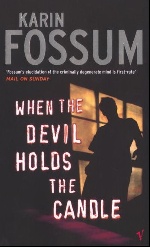
The third of Karin Fossum's books to be translated into English is When the Devil Holds the Candle. In my mind it's the best of the three.

I expect people who write successful series of mysteries to establish a pattern and pretty much stick with it. Fossum does some of that. All three of these books are set in or near a small city outside of Oslo. Most of her books are written from a first person person perspective. Inspector Konrad Sejer and his young assistant Jacob Skarre are characters.

But, Sejer and Skarre have grown and changed over the course of the three books I've read. Sejer has changed enough that I wonder if there was a book between this one and the previous one that wasn't translated or perhaps wasn't written.

What sets When the Devil Holds the Candle apart from the earlier books (and from most mysteries) is an almost philosophical consideration of evil, wrongdoing, wrongdoers, and victims that goes beyond anything of Fossum's I've read before.

I say almost philosophical because it's really more of a description of how thin the lines between victimizer and victim are sometimes. And there's a big question raised about the difference between being responsible and being a witness. The stories in the book also ask questions about trust, about betrayal, and about social norms. But the book doesn't offer answers. Not even the characters in the story offer answers. Any answers have to come from readers.

Most of the book is told by a very disturbed woman, who it seems, has good reasons to be unhinged. Once again, Fossum presents mental illness through the words of the sick person. Once again, it's frightening. The illness in this book is more understandable than the schizophrenia she presented in He Who Fears the Wolf, but it's still powerful. There are other stories, told by other people that support the central one. Most of them raise subsidiary questions.

All the stories are well-told. I read this over Christmas weekend in fits and starts, but every time I had to put the book down, I was unhappy with the interruption, even when it meant being part of the family observances and meals. There was enough foreboding to make me believe that the next bit of the story was likely to be dark, but I wanted to know what was going to happen.

When I finished reading it late on Christmas day, I let out a big sigh. The dark story was over. I was glad it was only a story in a book. I'm less scared of the nasty imaginary demons of frightful books and movies than 60-year-old Irma Funder of Prins Oscars Gate 17 in Karin Fossum's Norway. Or perhaps Irma's son.


16 December 2006

Unexpected Rookie Treat

When someone recommends books that I enjoy, I pay particular attention. So it is with Dan Conrad's recommendations. (See my reactions to Karin Fossum's books below.)

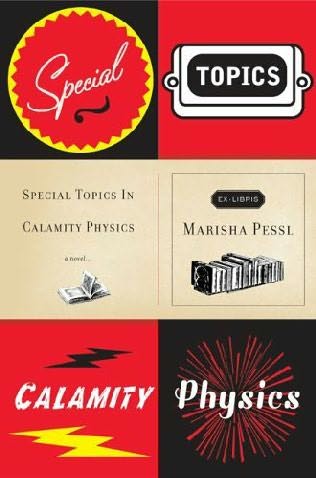
Dan mentioned he'd just read Special Topics in Calamity Physics. My response was, "That's a pretty off-putting title for a novel." He wrote back with some details about Marisha Pessl's Special Topics in Calamity Physics.


"One further word on what I wholly agree is an off-putting title of Special Topics in Calamity Physics.

"The whole book SHOULD be off-putting. I mean who needs to read a long book by (judging from her picture) a pretty (in a snobby Bryn Mawr sort of way) young woman who looks like a young (and smart and smart-ass) Jackie Collins and who writes a novel that, for about 1/2 of it, reads like intellectually show-offy adolescent chick-lit about overprivileged preppies. Ugh.
 

"So, you can imagine my surprise that I became captivated by it, hated to have it end, began to see what that early stuff was actually about, and have thought about it for days afterward. Go figure.

"I believe it's the most engaging book I read this year AND YET I am not at all sure if, and to whom, I would recommend it. I can easily imagine someone just hating the thing. If it intrigues you, I have attached the NYT Janet Maslin review that got me to buy the book in the first place."


Janet Maslin, the New York Times reviewer said this book is a "most flashily erudite first novel" full of "pirouettes and cartwheels... tireless annotations and digressions..." Maslin added, "A fledgling author who invokes Shakespeare, Flaubert and Allen Ginsberg for a tale of boarding-school intrigue had better live up to her grandiose aspirations. Otherwise she risks sounding pitiably overeager to impress."

Like, Dan, Ms Maslin warned readers that "Ms. Pessl shoehorns so many... asides into Special Topics in Calamity Physics that her narrative unfolds in a state of perpetual interruption... A 500-page headache is as possible as a bracing joyride." She also reassures us that "Special Topics in Calamity Physics soon jettisons its booster rockets and begins to soar... This book's gradual upward trajectory leads it toward mounting suspense, a hall-of-mirrors finale and a coda that is supremely inspired."

I'm cautiously curious about the book. I may go looking for it after the holidays. But, I don't know. The company the book keeps makes me deeply suspicious.


15 December 2006

Unexpected Norwegian treat

After taking Dan Conrad's advice and reading Don't Look Back, I went searching for the second of Karin Fossum's mysteries that has been translated into English, He Who Fears the Wolf. Well, I should say that I asked the Northfield library to go searching for it. This copy came from the library in Grand Meadow, Minnesota. I had to look up Grand Meadow to find out where it is. (It's a lake Wobegon-sized town about half way between Rochester and Austin in the southeastern part of the state.) Thank you, good people and librarian of Grand Meadow.

The book was an unexpected treat. I expected Fossum to follow up Don't Look Back with another "Inspector Sejer Mystery" (as the cover advertises). I enjoyed that one.

That's part of what is in this book. Inspector Sejer and his young assistant are once again investigating a murder in rural Norway. Once again the Fossum has a good story to tell and does it well. It's not quite as clinical as the earlier book, but that only makes it better. Widower Sejer is attracted to a woman for the first time since his wife died. That's all that's in this book: he's attracted and troubled and confused.

The unexpected treats are the wonderfully evocative descriptions Fossum writes of the people in the stories that make up this book. Even minor characters were described in ways that let me create very clear images of them. Maybe she did that in the earlier book and I wasn't noticing. This time I noticed. Each time a character was introduced I quickly had a mental picture in my mind of a realistic person. Fossum has a great skill for noticing and describing characteristics. I really enjoyed this book for that treat.

I also enjoyed the characters and a second complicated story within this book. There's a murder, an escaped mental patient, a run away boy, a bank robbery, and a getaway with a hostage. Not only are these characters vividly described, their stories are dramatically told.

Fossum's first person account of schizophrenia is frightening. I have no way of knowing how realistic it is, but it's dreadful. The bank robber and the runaway have their own problems, and they get presented in first person accounts as well. The bank robber is not as dramatically presented, and he's the least believable of the characters. But Fossum presents seven major characters in this book and gives unexpected depth to five of them. Given the cardboard prop characters that show up in many mysteries, that's quite an accomplishment.

So, this book was an unexpected treat. I highly recommend it.

Next, I'll have to ask the Northfield library to go searching for another Karin Fossum book.


03 December 2006

Out of Range

The title of C. J. Box's fourth mystery is Out of Range. Like the first three, the action centers around Wyoming game warden Joe Pickett.


The story is well told and the plot is interestingly convoluted. In the course of four books, Pickett has gone from being a marginally naive good guy to being a marginally naive man of action. He accumulates enemies that foreshadow coming books. I know from looking at a copy at Barnes and Noble that the menace in the most recently-published book originates in the first "Joe Pickett novel." And Joe's "allies" are more tenuous than his enemies. In this book, even his wife is questionably reliable (for good reasons).

The publisher likes to quote comments comparing Box's books to Tony Hillerman's because of the spirit of place that pervades the stories. However, Tony Hillerman's deserts are lyrically and beautifully drawn into his books in ways that Box might someday come close to when describing the high plains and mountains of northern Wyoming. And I like Hillerman's characters more than I like Joe Pickett, his family, and friends -- except for Pickett's oldest daughter Sheridan. She's 12 and headed for a rocky adolescence. Hey, C. J., write a story about Sheridan.

These books are good reading for traveling. I read most of this during our 1,100-mile sojourn at Thanksgiving. It would be a good book for a plane trip -- the first half on the outbound flight; the second half on the return. If you like mysteries, they're worth checking out. However, a surer thing would be Tony Hillerman's latest, The Shape Shifter, which I hope to read early in the new year.