19 July 2014

Tempted by Literature

Every once in awhile I get tempted to read something that's not a mystery. Non-fiction often works for me. Romance never has. Comedy is good. And there are times when I am tempted to read Literature. I guess I think I should read Literature once in awhile. After all, I'm an Educated person. On rare occasions, I am rewarded. More often I'm befuddled, disappointed, and/or bewildered.

Malie Meloy reviewed Evie Wyld's second novel, All the Birds, Singing in The New York Times. Somethings she wrote there tempted me to read Wyld's book. The review was better than the book.

It was sort of like a recipe that sounded good on paper, but in reality was a great disappointment.

I thought, based on the review, that the book was set on a small island off the coast of England. Turns out that much of the book is set in Australia. And I often couldn't tell where a particular scene was set. I thought the book was a biography of the main character, an independent woman who survived a particularly awful life. Well, it sort of was, but parts of the story were told in reverse chronological order. (There was one point at which three consecutive chapters were set in times earlier than their predecessors.) For someone like me who appreciates story telling, this was a disaster.

Somewhere in the confusing story, the main character did move from shearing sheep in Australia to raising sheep on a British isle. I have no clue about where in the story this happened. Wyld made a big deal out of the mysterious and deadly attacks on sheep by something. Was it brutal nature, delinquent teenagers, delusions, or something evil and ethereal? I never found out. The main character has horrific scars on her back, which she refers to several times. I have no clue about what happened to create them or what they meant to the main character.

Evie Wyld
I went back and read Meloy's review. She described things from the book that I can't remember. I guess I was just too befuddled, disappointed, and/or bewildered to catch on to the Literary illusions in Wyld's Literature. I did like the review better than the book, but it's only a little essay. I do like to read whole books. I do like to read books that effectively tell stories. I do like to read books where characters are introduced or who introduce themselves in whatever ways they are able to understand themselves. That didn't happen for me here. Maybe I was lured in by the photograph of the read-headed author.

Nothing explains to me why the reviews are all positive and why Wyld has won awards for her writing.

Have you read All the Birds, Singing by Evie Wyld? What did you think of it or what did you understand? Write. Tell this little bit of the world what you thought.


16 July 2014

Have I read this before?

One of the books I picked up at the Hospital Auxiliary book sale was Margaret Coel's Wife of Moon.

I have read several of Coel's mysteries set the fictional St. Francis mission in northern Wyoming. I began reading them about the time Tony Hillerman was writing less and Coel helped fill the void of a writer who created and maintained interesting characters, who brought beauty to a rather unwelcoming environment, and who told a good story. To me, it helped that many of Coel's characters were Arapahos on the Wind River Reservation and that she appreciated cultural differences. (It also helped that a friend of mine, who grew up on the res, could identify some of real life models for Coel's characters.)

The main recurring characters are a priest at the mission and an Arapaho woman who left the reservation for law school and returned to practice there. The barriers between the two make them "obvious" partners in solving crimes and protecting the innocent. In at least one novel, things swung perilously close to romance novel, but only one time.

At some point in reading the book, I wondered if I'd read it before. When I looked at the copyright date, I found the book was 10 years old.(It's old enough that you can download the book.) I didn't recall any scenes or plot twists, but I have read many of Coel's books. If I read it and wrote about it a decade ago, I'd have written about it in my first attempt at a blog about my reading. Years after we changed ISPs, our old one erased all our old web presence, so I can't go back and find out if I wrote about reading Wife of Moon.

Arapaho tipi
Never mind. This is a good story, well told. It's fictionally tied to a 1907 visit to Edward S. Curtis, the photographer famed for staging and photographing Native Americans before what he thought was their ultimate fate: dissolving into European culture. During a fictional reenactment, a chief's daughter, the wife of a white landowner is killed.
Wyoming by

The descendant of that land owner, a successful businessman and politician in 2004, is thinking about running for president. Is he part Arapaho? Did the land inherited by his grandfather from his Arapaho wife really belong to the tribe? Now the curator of an exhibit of Curtis' photos at the mission has disappeared. An Arapaho woman is murdered. An angry Jackson, Wyoming millionaire shows up threatening anyone he can corner. The Arapaho lawyer is trying to defend a client who has disappeared on a vision quest. The mission priest is trying to find out what is going on and protect his flock. Genealogy becomes important in answering questions. And are there really some of Curtis' glass negatives still around on the res?

Oh, and campaign staffers for the potential candidate appear to smooth over bumps in the PR campaign they're running.

It's a good story, well told.

Have you read Wife of Moon? What did you think of it? Write. Tell this little bit of the world what you think.


02 July 2014

Another old favorite

Paretsky and friend
Somewhere back in the ancient '80s, I first read a novel by Sara Paretsky. She made a big splash in the mystery writing world because her main character was an active, effective woman. Not that there hadn't been women detectives in fiction before. Think Nora Charles or Cherry Ames or Nancy Drew. But, Paretsky's V.I. Warshawski was neither the partner to a man nor a girl detective.

I found the character a wonderful contrast to the male/macho detectives I'd been reading. Plus, Warshawski lived in Chicago, not in New York or LA.

But Warshawski gradually evolved into the kind of hard charging, "damn the torpedoes," kind of macho detective that had persuaded me to stop reading most other mysteries (especially Sue Grafton's Kinsey Millhone).

I saw Paretsky's Breakdown on the bargain table at the bookstore. I hesitated. But the bargain was so good. I gave in and bought it. I'm glad I did.

Paretsky is still a very good story teller. Her characters are still recognizable and believable, even if there are references to vampires. Warshawski didn't do anything stupid, although she had a near death experience near the end of the story. Well, there has to be a climax. And the final scene in a television studio nearly earns an improbability award.

Nothing memorable here, but I'll live with it. It'll go on the pile for next spring's community used book sale.

Have you read Breakdown? Have you read other recent Paretsky novels? Write, and tell this little bit of the world what you thought of it/them.


01 July 2014

How old a favorite?

I first read a book by Walter Mosley when a newly elected President Clinton was photographed carrying a copy. How long ago was that? 1993? Holy cow! 21 years ago? Just 21 years? It's in that ambiguous time period that seems a lifetime ago, but a fairly recent lifetime. I had been teaching for 25 years by then. But where have the last 20 years gone?
Mosley

While I have liked most of Mosley's books, my favorite is still Always Outnumbered, Always Outgunned. I wrote about it in 2002 and reprinted that five years later.

At the community used book sale, I picked up a 2011 novel by Mosley, When the Thrill is Gone. It's another story about the life and world of Leonard McGill.

Following in the footsteps of many hard-boiled writers of hard-boiled detective novels, Mosley offers a tour of a very complicated and dangerous world. It's not quite the alternate universe of post-WWII Los Angeles that he used to write about, but it's very alternate to the my small town Minnesota world.

The characters are alternately attractive, repulsive, obvious, and enigmatic. The story moved along and never left me behind. I might well offer Mosley an improbability award, but there are too many parts of his world that I cannot evaluate. At times it was like reading science fiction.*

I liked reading When the Thrill is Gone. If I find another of Mosley's books at the used book sale or on the discount shelf, I will pick it up. (Right now, my problem is that I have five books stacked up on my bedside table, and one more I haven't written about yet -- another favorite from 20 years ago.)

*Rumor has it that Mosely has plans for a science fiction series to begin this year.

Have you read When the Thrill is Gone? Write. Tell this little bit of the world what you thought of it. Or write about anything you've read. I can always use new ideas. And so can you.


30 June 2014

Paying the price

There's a downside to spending a lot of time in a bookstore. Thankfully, the bookstore I'm spending time is is Barnes and Noble. They have a decent coffee shop and good quiche (which makes a great breakfast). Try to find those things at Amazon.com.

The downside is dealing with the temptation to spend money and the fact of having spent money.

I do try to limit myself to the bargain shelves, but I still spend money on things more than coffee and quiche.

Most recently, I bought Ian Rankin's The Impossible Dead. I expected the book to be another in his series about a maladjusted dectective, DI John Rebus. It wasn't.

The Impossible Dead is about Scottish cop Malcolm Fox. Fox leads an internal investigation team, which means he's automatically suspect by other police officers. Fox is charged to investigate the colleagues of a discredited detective who are suspected of covering up for their less than stellar colleague. Hardly anyone is friendly to the visiting cops' cop.

Then there's a murder committed with a gun that was recorded as having been destroyed 30 years earlier. And there are more links to troubled times in Scotland's past, when nationalists were active and more violent than the present day advocates of independence. (You do know there's a referendum on Scottish independence in September 2014, don't you?)
Rankin

There's also a 30-year-old murder that seems to need sorting out. And important people who may have been involved in a murder or the non-destruction of a murder weapon.

Oh, and DI Fox has a personal life too. His father is in a memory care facility and his unemployed sister is angry that he doesn't help out more with their father. And, yes, he has to deal with those people as well as the cops he works with.

It was a good and easy task to read through Rankin's prose and plot. It was good not to have to read about Rankin's maladjusted "star."

Have you read The Impossible Dead? What did you think about it? Write. Tell this little bit of the world what you thought.


16 June 2014

Primary basketball season is over. School's out. Guess who has time to read.

None of that is quite true. Dale Stahl, a former colleague and newly named department chair is involved as a coach in basketball pretty much year round. And he e-mailed me back in mid-May (about the time his AP Econ class was pretty much over). Plus, it seems he read these books sometime earlier.

And I'm trying to figure out why I didn't get to his note sooner. Sorry, Dale. I have no excuses. Tell us more about Dead Lions.

Here's what he wrote:
Herron
Found a new author I absolutely love - Mick Herron.

He has two books set in London amidst the intrigue of the British MI5 secret service. Slow Horses and Dead Lions.

The basics plot element is that the "slow horses" are agents who have made some monumental mistake that has put them on a career path of being slowly but surely drummed out of the secret service.
Far from Regent's Park, the center of power, they are assigned to lowly tasks at the slightly decrepit and depressing Slough House. The leader of the slow horses is the overweight and seemingly burned out Jackson Lamb — a veteran of the cold war and a man with many secrets who still has his finger on the pulse of things, so to speak.

The books are phenomenal, Great intricate plots, twists, suspense without gratuitous violence, old fashioned page turners. I can see them as films and I certainly hope Herron adds a third book to the list!


15 June 2014

Which way now, Huck?

I was delighted with John Straley's Cold Storage Alaska. Even though I got a Lake Wobegon-like story instead of the mystery I expected, Straley got me interested in his characters and kept me entertained.

In the afterward to that book, I learned that there was a prequel of sorts that was published several years before Cold Storage Alaska. I found that prequel at Barnes and Noble and snapped it up. It's called The Big Both Ways.

Annabelle was the matriarch of the community in Cold Storage, Alaska that Straley wrote about. In The Big Both Ways, Annabelle is a young adolescent on the run with her aunt, Ellie Hobbs, who is involved in radical politics, the Wobblies, organized crime, and the cops. After disposing of an inconvenient body, the two of them are joined by Slippery (Slip) Wilson, a logger who quit his job after seeing his best friend die in an awful accident. All three are headed for Alaska, new starts, and ways to make a living.

The book is the story of how this unlikely trio got from the forests of central Washington to a tiny town on the inside passage of southern Alaska. And it's the story of a Seattle cop who kept trying to follow them. (But when he finds them, he only wants to know what really happened. Then he quits his cop job and becomes part of the Cold Storage community, known by Annabelle as Uncle George.)

But this novel is not really a mystery. Somebody wrote that it was a Jack London like story. I don't think so. I think it's an early 20th century, west coast version of The Adventures of Huckleberry Finn. The river isn't the Mississippi, but it's the inside passage. And it doesn't flow south all the time. It flows south and north, depending on the tides ("big both ways").

The adventurers aren't seeking freedom for Jim, but they are seeking freedom for themselves by getting lost in unfamiliar country. They're being chased by George the detective, by some union thugs who are out to capture a traitor, and by some gangsters who want money they believe Ellie Hobbs has made off with.

The little trio row their hearts out in a skiff, catch rides with questionable characters in big boats, evade Canadian customs, fight the tides, get shot at, and poach a farmer's lamb.

Like the story of Huck and Jim, it's difficult to imagine exactly how they survived and made it through the travails of travel. But I was really glad they did. I was cheering for them from the second third of the book.

Once again, I liked the characters and was entertained by their adventures. I certainly hope John Straley writes more stories like these. Mysteries would be okay too, but modeling stories after Garrison Keillor, Mark Twain, or Jack London works pretty well.

Have you read The Big Both Ways? Write and tell this little bit of the world what you thought of it.


08 June 2014

A familiar book

One of the books I picked up at the community used book sale was The Singing of the Dead by Dana Stabenow. Not only used, it was a paperback. And I bought it on the last day of the sale when everything was "half price."

I might have read this book before. It was published in 2001. I can't go look it up, because our former Internet host finally took down our old web pages where I once posted these little reviews online. (It has been 8 years since we switched.)

I didn't remember any of the plot, scenes, or clever lines when I read it. But it was familiar because I've read so many of Stabenow's books. Familiar characters, familiar settings, familiar culture...

Stabenow tells great stories without superfluous words or events. There really aren't any red herrings either. Freelance detective Kate Shugak gets hired to be security for a political campaign (the candidate had received threats). Along the way, bits and pieces of an unsavory past (some of it 100 years past) pop up. Shugak has to tie the past to the present in order to identify the danger to her client. Oh, and she's also helping a teenage runaway play hide and seek with his angry and abusive mother.

Three stories to tell and they were all interesting to me. This was one of the books that kept me from just sleeping in the hammock over Memorial Day weekend. It was a great weekend and the book helped.

Have you read The Singing of the Dead? If so write and tell this little bit of the world what you thought about it.


21 May 2014

Uncomfortable cozy

This year I have read a gut-wrenching mystery set in Kenya, a tale of rogue bankers and child molesters in Iceland, a bait and switch mystery in Norway, a narrative about recycling and reuse, essays about the universe, a rather pleasant story about a village in Alaska, and an imagining of Plato in the 21st century USA. Except for Cold Storage, Alaska, it seemed pretty steep for me in my spare time. So, I figured I could pick up a "cozy" and just read through the mystery.

A cozy is a rather demeaning lable given to a mystery that keeps the awfulest stuff and sex in the background. Most "locked room" mysteries are cozies. (Some become horror stories, but that's a cinematic detour.) The locked room mysteries were a European invention where murders happened in isolated, old manor houses or castles and all the people involved were suspects and were confined to the house or the dining room or the parlor until the murder was solved, the storm abated, or help arrived from far away.

To me the term cozy descirbed all those murder mysteries that took place in TV's Cabot Cove, Maine. So I was in the mood for something entertaining and undemanding.

I picked up Louise Penny's How the Light Gets In. Penny's books that I'd read before (Still Life and A Fatal Grace) were pretty cozy, and I expected something similar. That's not what I read.

Well, it's my fault for not reading all of the Inspector Gamache novels. One of the earlier books hinted at nefarious plots in the Quebec police department. But it sounded like office politics. How interesting could office politics be?

Well, it wasn't just office politics and How the Light Gets In isn't just a mystery and isn't quite a cozy.

A lot of the story is set in Penny's village of Three Pines (her version of Cabot Cove), but the narrative extends to Montreal and northern Quebec. One part of the story was about the death of the last of the Ouellet Quintuplets (Penny's version of Ontario's Dionne quintuplets). [The Dionne quints were a big deal for my mother who was 11 years old when the 5 little girls became popular celebrities.] If Penny had stopped with that story, the book would have been a real cozy.

But the other huge story is about political and police corruption and has its roots in Inspector Gamache's first big case thirty years earlier. Some of it is told in explanations offered by the author. But there's a LOT that's not told and that makes the ending pretty lame. Hey, Louise Penny, do you like the Improbability Prize I offer this plot?

That ending aside, Penny creates great characters and tells good stories. And the action scenes near the end of the book were good enough to convince me to finish the book early in the evening so they wouldn't keep me awake at midnight. I enjoyed this. And Inspector Gemache is likely to make a reappearance even if he's retired from the Quebec police. I'll look for another (its publication date is August 26), but I won't automatically assume it's a cozy.

Have you read How the Light Gets In? What did you think of it? Write and tell this little bit of the world what you think.


Okay, okay, last minute discovery. The CBC has produced a two-hour television movie of Penny's first book, Still Life. Check out the promo.


07 May 2014

I used my free will to read philosophy?

My daughter gets part of the blame for this. Back when she was a senior in high school, she and some friends convinced a colleague to teach a little philosophy course for them. My colleague was a philosopher at heart and jumped at the chance, even though it added to his teaching load.

Skip ahead a decade and my colleague retired. I inherited teaching the course (but as part of my regular teaching load).

As an undergrad, I'd been intimidated by higher math and by my mathlete friends who were fans of the philosophy department's logic courses. I avoided both disciplines as much as possible.

Walter Cronkite in '53
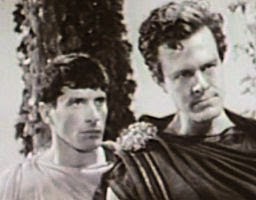
Somewhere along the way I read Plato's Apology. My understanding of it benefited from a 1953 CBS episode of You Are There in which actual CBS reporters "showed up" at the prison where the Socrates was orating and interviewed observers. Some of the actors in the scene were Robert Culp as Xenophon and E. G. Marshall as Aristophanes. Paul Newman and John Cassavetes are both given credit for playing Plato at IMDB.com. Walter Cronkite was the anchor at the studio desk and interacted with the reporters at the scene. Oh, and Sidney Lumet directed this episode. The TV production was based on a 1948 radio script.
Cassavetes as Plato; Culp as Xenophon

That's how shallow my understanding was. (Go ahead. Ask me if I get sidetracked sometimes.)

Luckily, my colleague left behind lots of great teaching ideas. I got interested. Since I couldn't ad lib about anything philosophical, I had to read a lot on my own and come up with teaching ideas too. And I think I created some good ones.

All that is prologue to reading Anthony Gottlieb's review of Rebecca Newberger Goldstein's book, Plato at the Googleplex, Why Philosophy Won't Go Away. A couple people later panned the review, but it persuaded me to buy (yes, buy) a copy of the book and dig into it. (That digging took awhile. That's why I haven't written anything here for six weeks.)

There are two kinds of chapters in the book. One set of chapters are essays on Platonic and Socratic ideas and the culture in which they were created. The one I latched on to best primarily addressed the question of why the 4th century BCE in Greece was different from the centuries that preceded it in other places. Other chapters describe the culture of Athens, explain Socrates' decision to die, and analyze Plato's famous cave.

Alternating with those chapters are episodes in which Plato appears in the present-day United States. He visits a philosophy class. He goes on a book tour to promote his work that includes a stop at the Googleplex, the corporate headquarters of Google, Inc. to discuss crowdsourced ethics, a debate at the 92nd Street Y about child rearing, a session with Dear Margo, helping her answer questions from readers, an interview with a dismissive, right-wing radio host, and a session with a neuroscientist and a cognitive scientist about free will. That debate ends as the scientists are about to observe the operation of Plato's brain using functional magnetic resonance imaging (fMRI).

In each of these chapters about the 2400-year-old philosopher visitng the USA, there's a dialogue. Maybe they're modeled on dialogues Plato wrote. (Someone more knowledgeable will have to tell us.) But for the first time I sort of understood what was being debated. I reveled in those chapters. In his review, Gottlieb suggested that the philosophical essays were more valuable and the imaginary dialogues could have been omitted. I think the opposite is true. I read the words of the essays, but I didn't struggle to understand them. I did concentrate on the dialogues. The book is over 400 pages. I'd be okay with losing the essays.

So now it's up to you to read Plato at the Googleplex (I think it's worth the time) and tell us what you thought of it. Write and tell this little bit of the world.

Or, if you've read something else you would like to recommend or advise avoiding, you can write too.


20 March 2014

Lake Wobegon, Alaska

I was feeling a little flush. Probably a budgetary bad way to feel when I'm in a bookstore. It can contribute to deficit spending. So I bought a book.

As big as life on the new mysteries shelf was John Straley's Cold Storage, Alaska. I had good feelings about Straley's earlier books. Goes to show how I'd forgotten the most recent one, The Angels Will Not Care. I've read at least one other, but my written response is buried in the paper files of the old newsletter.

Well, whatever shortcomings I found in The Angels Will Not Care are forgiven.

I started reading Cold Storage, Alaska thinking it was a mystery. It was a reasonable assumption for most of the first half of the book. But about half way through the book, I realized that Straley wasn't writing a mystery, but he was writing a Garrison Keillor-like story of an Alaskan Lake Wobegon (or a seaside version of Cicily, Alaska from Northern Exposure). And he was doing a damn fine job.

Cold Storage is a tiny sea side village that once had a thriving fishing-based economy. Then freezing fish replaced canning fish and the village went into decline. But the story is really about the people who wash up in the backwater of the Alaskan coast. And Straley does a wonderful job of populating the town with natives, returnees, and haphazard immigrants. Like the Norwegian- and German-American residents of Lake Wobegon, the people in small town Alaska are interesting and attractive once you get to know them. And Straley creates characters who are easy to get to know.
Hoonah, Alaska (could be a prosperous version of Cold Storage)

There's Miles, the former army medic who is now the town's physician's assistant (even though there's no physician to assist). Miles' brother, Clive, returns to town with a pile of cash after serving a prison sentence for drug dealing. There is a group of cruise ship refugees who appear just as Clive is rehabbing the old family bar and in need of a house band. Ed and Tina are teachers in the Cold Storage school. Billy is an old fisherman who sets out in a kayak on a fund raising mission to meet the Dali Lama in Seattle and returns with Bonnie, the woman who rescued him when his kayak sank. There's the Alaskan state trooper who is anxious to bust Clive for returning to his old occupation and two of Clive's old criminal buddies who want the money Clive made off with.

If I compare Cold Storage, Alaska with the last of Keillor's novels I read, Pontoon, this is head and shoulders above what the Old Scout turned out.

I learned that this is one of two "Cold Storage" novels Straley has written. Somehow I missed the one about the parents of Miles and Clive, The Big Both Ways. Now, I get to find that book. I don't know if that will be as good as this, but I heartily recommend Cold Storage, Alaska.

Have you read Cold Storage, Alaska?  

Write. Tell this little bit of the world what you thought.


10 March 2014

Science without the fiction

I know I've told the story of meeting and talking to Stephen Jay Gould and Richard Leakey. They were speakers and I was an attendee at a conference. The three of us were in the shelter of a building where Leakey and I could smoke. Gould just wanted to talk to Leakey. So did I. So I hung out with them for a few minutes. I must have told the story in the ancient printed version of this blog because the only reference I can find to the story online is in Stephen Jay Gould, 1941 - 2002.

After meeting Gould, I began reading his essays. Books full of them. They were (are) masterpieces of exposition and art. One of my favorites is Dousing Diminutive Dennis's Debate, arguing, years before the millennium, for the the importance of the year 2001.

Recently I picked up a book of essays by one of Gould's successors at Natural History, Neil DeGrasse Tyson. I'm impressed by Tyson's interviews and good humored appearances on television. I wrote about one of his essays here last year, More non-fiction .

The book I picked up was Death by Black Hole. Tyson, is good. He's not Stephen Jay Gould great, but perhaps no one will ever be. Some of the same questions I asked when I last read "The Importance of Being Constant" rose in my head when I read it this time. Go look at my physicist daughter's response.

Tyson won me over in an early essay by noting that "One of the challenges of scientific inquiry is knowing when to step back -- and how far back to step -- and when to move in close... A raft of complications sometimes points to true complexity and sometimes just clutters up the picture." That's an important lesson I strive to teach students.

Over and over Tyson points out lessons like that. Sometimes his analogies are too complex and sometimes his explanations are inadequate for my little brain. But I enjoy what I read and I learn things. But I didn't finish the book yet.

It has to go back to the library. I might have finished it, but Eric Johnson lent me Junkyard Planet (see below), and I wanted to read about recycling and see what my former student had written. I might check Death by Black Hole out again and finish it. But right now I'm sated on non-fiction, and I have two new books on my shelf.

So have you read Death by Black Hole or other essays by Tyson? What did you think of them? Write. Tell this little bit of the world what you thought.


05 March 2014

Minnesota junkyard boy far from home

Once upon a time, a long time ago in a classroom not too far from here, a young man was a student in a class I taught. He became a Shanghai-based journalist. (He is one of two Shanghai-based journalists I got to know when they were students, but that's a story for another time.)

The young man grew up helping to run the family business, a "junkyard" in north Minneapolis, not far from where my parents grew up, but that's also a story for another time.

Adam Minter started his career writing about the junkyard/scrapyard/recycling business in China. I had no idea there were specialized journals about such obscure topics. Goes to show what I know.

I caught up with Adam Minter a few years ago, when I ran into an article he wrote for The Atlantic. Then I found his blog -- about the scrapyard business in China. It seems he wrote enough episodes in his blog to convince someone (maybe Minter himself) to write a book about the topic. My friend Eric Johnson had just read it and mentioned it one morning. When I claimed acquaintance with the author, Eric loaned me the book the next day.
 Junkyard Planet, Travels in the Billion-Dollar Trash Trade was published last year. It's been noticed far beyond the scrapyard/recycling world and it's earned good reviews globally.

The reason it's been noticed is that this goes beyond telling stories about the entrepreneurs in China who have built a business dependent upon importing cast offs from the USA, Europe, and Japan (although those stories are often interesting).

Minter offers abundant data on the vast scope of the global trade in trash and the ways it is changing. He also explains the mysterious processes used to extract value from trash (like harvesting copper wire from discarded strings of Christmas lights which are sent to China in huge bales that fill many shipping containers).

But he forcefully makes that point that much of the value in trash from Japan and the USA comes not from recycling, but from reuse. Old cell phone screens become screens for hand-held video games. Discarded computer chips become the hearts of new game counsels. Discarded computers and monitors become affordable computers for Chinese homes.

In fact, Minter repeatedly makes the case for the importance of reuse and how reuse is more important for our futures than recycling.

Minter writes well. He circles his topics and keeps coming back to his main points. His data seems as complete as it would be for a term paper. Luckily, he doesn't write like a student. Junkyard Planet, Travels in the Billion-Dollar Trash Trade is an enlightening book. I encourage everyone to read it. It's important stuff. At least catch up with Adam Minter's blog, Shanghai Scrap or his Twitter posts, which you can follow on Facebook.


Have you read Junkyard Planet? Write and tell this little bit of the world what you thought about it.


28 January 2014

Miracle superhero

The stories in some books pour off the pages like slick water. Other stories come out of books like cold, thick molasses, and then only with a lot of work. Jo Nesbø's Police is one of the latter.

I think those molasses-like stories are often more interesting to read. Not necessarily better, but more interesting.

Police is intense and interesting. Often too intense for me. I skimmed through several sections looking for semi-climaxes.

Nesbø spins a good yarn and writes suspenseful action scenes. Many of the scenes are theatrical. Several times in the book he dangles red herrings as he narrates some action, only to sweep them away and reveal deception at the end. It's neatly done, but it's also a somewhat nasty trick to play on readers.
I could never be sure I understood what had happened until I read the post-action description that Nesbø has to include or no one would blame you for thinking his hero is crazy to talk about a surprise present as he walks into a room where he knows a psychopath has a gun aimed the hero's son and fiancé.

Oh, and remember the special awards I give out to stories that needed superheros and unbelievable good fortune to work? Well, Police earns both the Green Lantern superhero and the Heart of Gold improbability awards.

The Heart of Gold
Green Lantern

If you're not willing to tolerate an unbelievable superhero and enough improbability to send the Heart of Gold across the universe a couple times, stay away from this book. Otherwise, enjoy it like a good Batman story.

Have you read Police? What did you think of it? Write and tell this little bit of the universe.


14 January 2014

Well, I suppose. If I have to.

I seem to remember a robot character in Restaurant at the End of the Universe who was resigned to his status and his duty. It was constantly saying, "Well, I suppose. If I have to."

Arnualdur is an Icelandic mystery writer. I've read at least three of his books in the past five years. I remember The Draining Lake and Voices as being good.

Inspector Erlendur, the main character reminded me of Douglas Adams' robot. His approach to life was "Well, I suppose..."

At the library recently, I found a new novel by Arnaldur Indriðason, Black Skies. Inspector Erlandur is gone. His protege, Sigurður Óli steps into the main role in this book. If anything, Sigurður Óli is more phlegmatic and self-centered than his mentor. With a main character like that, the story has to carry the burden of the novel. I always knew that Sigurður Óli would act like he was saying "Well, I suppose. If I have to."

The story does carry the book. There are actually two stories. One is a case study of the banking corruption that brought economic disaster to Iceland in 2008. Two murders, seemingly unrelated at first, lead Sigurður Óli to a small group of bankers and a complex multinational plan to make piles of money.

The second story is about sexual abuse of children. It's while trying to make sense of the ramblings of an old drunk that Sigurður Óli actually seems to grow as a person. I don't know if that was intentional on Arnaldur's part or one of those things that takes over during the writing of a book.

That second story is more interesting and more awful. What is it about the Icelanders and depression? Not enough sunlight in the winter? Too much in the summer? The first story portrays the Icelandic bankers as just like the American and British bankers who saw nothing wrong with playing fast and loose with other people's money in order to make obscene profits by finding loopholes in the law.

The book was good. Not great, but worth the time.

Have you read Arnaldur's Black Skies? What did you think of it? Read anything else lately? Write and tell this little bit of the world what you think.


09 January 2014

Complications in Kenya

It seemed to take forever to reread Sirens of Titan. Then I read at seeming light speed through Margaret Coel and Dana Stabenow's books. I think familiarity with the styles and characters of those authors made reading their new books less daunting. (Although Stabenow threw a curve at the end.)

So, I wasn't surprised that reading a first novel was slower going than the previous two.

Richard Compton was born in London, UK and lives in Nairobi, Kenya and his first novel is set there at the time of the 2007 elections.

Kenya is one of three African countries I know enough about to be utterly mistaken about any evaluation I might make. I first got interesting in Nigeria when I met a Nigerian classmate as a first year college student way back in 1963. I've taught about Nigeria off and on since 1970. I studied and taught about Kenya back in the '70s as well and taught about South Africa in the last years of Apartheid. (I have a ballot from the 1994 South African election on the wall above my computer.)

So Richard Compton told a fascinating story that took me back to what little I knew about Kenya and its capital city. The book was published in the USA as Hour of the Red God. It also shows up in the UK at Amazon.co.uk as The Honey Guide.

Compton's book is absolutely within the mainstream of Western detective fiction. And the main character might be a former Massai warrior dragged into the big city, but he's as much a British or American law officer as any in Anglo-American murder mysteries.

The story is also in that mainstream, even though the names, adjectives, adverbs, and even some of the verbs are Kenyan. That's one reason the beginning chapters were slow going for me.

There's murdered prostitute, a possibly stolen baby, a rich evengeical pastor, an ambitious and educated pastor's wife, various political high flyers, and of course a detective who doesn't always follow orders and his skeptical assistant. All of this takes place at the time of violence and tumult that accompanied the presidential election. (That's the same link as the one above.)

Compton weaves a fine tale. It's at least as complex as Dana Stabenow's Alaskan tale and more convoluted than Margaret Coel's Wyoming replay of the Custer battle. I really liked it.

And, I suspect he'll write another. His days as a BBC reporter are probably over. Compton's name goes on my list of books and authors.

Have you read Hour of the Red God or The Honey Guide? What did you think of it? Write and tell this little bit of the world.


01 January 2014

Reading about the past in the present

Sometimes I can't get enough time to read. Other times I can't find enough energy to read. In the weeks leading up to Christmas, I found both the time and energy. Now, I'm trying to find time and energy to write.

I started with a trip to the library and finding a new book by Margaret Coel on the shelf. Many of her books have been interesting and entertaining. Some have been too close to frustrated romance novels. I took a chance and checked out Killing Custer.

A crazy old historical reenactor was channeling "General" Custer and traveling around the west marching in parades, acting in reenactments, and giving speeches in character. When he shows up in Lander, Wyoming for a parade, the local Natives are not pleased. Some of the young men, also riding in the parade plan to insult the Custer character with a "dare ride." Part way through the parade, two lines of Native American riders ride rapidly outside of the Custer riders, circle the group, and ride off ahead of the reenactors. The trouble was that the old crazy guy chanelling Custer was dead after the maneuver.

As might be expected the leaders of the dare ride are blamed for the murder and the local police and the FBI begin looking for them. One of the suspects turns to Father John O'Malley for help and refuge. Father John, in turn puts him in touch with local attorney Vicky Holden.

The set up is almost irresistable. The story is well told. I read it quickly and with excitement. It was a dramatic contrast to the effort I had to put in slogging through The Sirens of Titan. This is one of Coel's better books. Some central Wyoming color, interesting people, perplexing mystery. I liked the book and I liked reading it.

Before I'd even finished Killing Custer, Nancy went to the library and brought back a new mystery by Dana Stabenow, Bad Blood. Stabenow is another writer whose books I've moslty liked. It didn't take much for me to pick it up and get engrossed in the story as soon as I'd finished Killing Custer.

I don't want to pretend this story has any classical aspirations, but Bad Blood is a Romeo-Juliet or West Side Story retelling. It's closer to High School Musical or Shakespeare in Love than to the Shakespeare original. Stabenow's story does have a very bloody ending, though.

Two clans in villages on opposite sides of a small river. One village is prosperous and growing. The other is poor and disappearing. The two clans are rivals and embittered neighbors. There are killings that seem to be the result of feuding. There are young lovers, from opposite sides of the river, trying to escape.

Alaska Trooper Jim Chopin and his lover, the influential Kate Shugak are on the job to investigate the murders, prevent further feuding, and find the young lovers.

What they don't know is that someone is stalking Kate Shugak, seeking revenge for a killing in the distant past.

This story is even more smoothly told than Coel's story. It's easy to read and to enjoy.

SPOILER ALERT: However, when the main character and her faithful wolf/dog in 19 of Stabenow's book catch bullets in the final bloody scene, it's shocking. Almost as shocking was Stabenow's response to an interviewer's question of whether she'd killed off her long time heroine. The author said she'd be crazy to that, but that the last scene would guarantee big sales of the next book. Sales sagging, Dana?

Have you read either of these? Have you read something else that you reacted to? Write and tell this little bit of the world what you thought.

19 December 2013

Titan revisited

I wasn't prepared for the opportunity to do some reading. I hadn't been to the library or a bookstore.

Then I saw a very old copy (printedin 1967 when the ISBN was just an "SBN") of Kurt Vonnegut, Jr.'s The Sirens of Titan.

I was enthralled with the book 40-some years ago. It was full of ideas and jokes that were brand new to me. This time when I read it, it seemed a lot less like fiction or satire.

The mega-story is a huge shaggy dog tale. The main characters, like most of us, have no idea of their roles in the human saga. The NSA is real, and the Traflamadorians are fiction, but it's difficult to determine which is more destructive. Just like it's difficult not to laugh out loud when the CEOs of Google, Facebook, Apple, Yahoo!, and LinkedIn plead with the president in Washington, D.C. to rein in the government invasion of people's privacy.
A Sirens of Titan tattoo

After re-reading it, I still like The Sirens of Titan. But I'm an old man now, like the main character, and I'm less amused by human or machine foibles.

Bring on the children. They're cute and wonderful. They'll grow out of that, but I want to spend time with them now. And eventually give them their own copies of The Sirens of Titan.

Meanwhile, "Greetings."


05 December 2013

Singaporean detective

Looking for a new series of mysteries?

Danny Yee, an Australian whose recommendations have been good in the past, has this:

Inspector Singh Investigates by Shamini Flint


  • A Most Peculiar Malaysian Murder
  • A Bali Conspiracy Most Foul
  • The Singapore School of Villainy
  • A Deadly Cambodian Crime Spree
  • A Curious Indian Cadaver
  • A Calamitous Chinese Killing

  • Inspector Singh is a Sikh working for the Singapore police, whose investigations so far have taken place in Malaysia, Bali (Indonesia), Singapore, Cambodia, India and China. The series is tied together by Singh's character and the foreign settings, in which he usually ends up working unofficially, with some help from elements of the local police... 
     
    "What makes these novels a success, however, are their individual stories. These are entertaining and well-paced, with a bit of suspense and some surprises, and they have a good cast of characters — in almost all of them families and family connections play key roles. And Flint may not have literary pretensions, but she writes straightforward and effective prose... "

    10 November 2013

    Long time no read?

    Nook
    No! I've been reading all along. It's just that the last few things I've read were on my Nook. Somehow, finishing a book on the electronic tablet makes it difficult to write about. I have no idea why, but I don't have a book to look at and refer to when I want to write about it.

    For instance, I read The Last Detective by Peter Lovesey. Lovesey had been recommended by someone somewhere and I began with his 1991 novel. It's about a detective working in England at the beginning of the era of computerized record keeping. He, of course keeps insisting that good old-fashioned human detecting is better.

    I have vague, rather fond memories of the book.

    Then I read The First Patient by Michael Palmer. It's a story about a doctor in rural Wyoming with guilty secrets who is asked by a college friend, who was president of the USA, to come to Washington to be his personal physician. That's about all I remember. When I looked up Michael Palmer, a physician who wrote novels, I learned he died last month.

    I read a short story by Connie Willis called All Seated. It was a semi-amusing science fiction story about first contact.

    Then I read another Willis story called D.A. It was more interesting and posed a clever question: How do you recruit loyal, but skeptical members to a national security organization. It was written in 2007, well before Edward Snowden.

    Dana Stabenow describes Conspiracy as an extended character sketch of a few recurring characters in her Kate Shugak novels. Yep.

    I read James R. Benn's Billy Boyle, A World War II Mystery. Some of it takes place in Norway.

    I read Edwin of the Iron Shoes by Marcia Muller. It takes place in a couple antique stores. Talk about a "cozy."

    Then there was Deadly Stillwater by Roger Stelljes. The Stillwater here is a town in Minnesota, not a placid pond. It was a good mystery about a a St. Paul detective trying to find a kidnap victim, who is the daughter of the capital city's wealthiest and most successful lawyer. Good action scenes and well described detective work. I liked reading this one.

    Oh, and Kate Atkinson took me in again. I've thought some of her books were fantastic. In Life After Life, she trots out seemingly endless story lines about versions of life and death of her main character. I looked up the New York Times review to remind me of the book since I'd done my best to forget it. That's why I can tell you that much about it. I did not enjoy slogging through a book when I had to start over every few pages.

    I read Mark Shroeder's The Book of Margery Kempe. (I think Dale Stahl recommded some version of this.) There are several versions, including an alleged autobiography of this 14th century mystic from England. It bears resemblances to Life After Life.

    I've now read everything on the Nook except Pride and Prejudice and A Beacon so Bright, a Biography of Laurence McKinley Gould. Gould was a president of Carleton College in the '50s and early '60s. The biography was written by the college archivist. Nancy edited it and saw to its conversion to an e-book, which is why it's on the Nook.

    Now to real books.

    Schwebebahn car
    A long time friend who teaches English in the picturesque German town of Wuppertal was in Scotland last summer. (Two special attractions of Wuppertal to me were the Schwebebahn and the Engles family factory museum. Yes, Karl Marx's writing partner grew up in Wuppertal and the family business helped support Marx during his years of thinking and writing.)

    In any case, while in Scotland, my friend ran across Glencoe and the Indians by James Hunter. Hunter is a Scot who was intrigued by the fact that Highlanders left Scotland to become fur traders in what is now Montana and Idaho, some working for the Hudson Bay Company and others for competing American companies. Not only that, there's a major
    Lake McDonald
    lake and mountain in Glacier National Park named McDonald, after one of those Highlanders. Add to that bits of anthropology, sociology, and politics that help compare how the English treated the Highlanders and how the European immigrants in the USA treated the native peoples in places like Montana and Idaho. Oh, and lots of people and nearly all the political leaders of the Salish tribe in Montana are named McDonald. Astrid knew I'd be interested and sent me the book.

    If only Hunter hadn't written the book like he had to tell all the stories at once. There's hardly a paragraph that doesn't include one, two, or three parenthetical back or side stories before reaching its conclusion (see above where I begin to write about how I got the book and got sidetracked with the Schwebebahn and Fredrick Engels). I skipped a lot of those asides. The idea of the book was more interesting than the book.

    However, Hunter does conclude that the Highlanders, given the social safety net the UK, came out of their domination by the English better than the native peoples of Montana and Idaho came out of their domination by Americans. Nowhere in Scotland, is there poverty like that on the reservations of those American states.

    Finally, there's Qiu Xiaolong's Enigma of China. Qiu is an immigrant to the USA. He's a poet and the author of eight mystery novels featuring Shanghai detective Chen Cao. The Shanghai settings are contemporary, so the city is practically alive with growth and change. At the same time, Detective Chen is an assistant Party Chairman in the police force, and the Party works assiduously to maintain its power and position in the face of change its leaders have set in motion.

    BMW Shanghai cruiser
    The plots of Qiu's novels always involve some of the conflict between the inertia of change and the inertia of stability and between rule of law and corruption. Some of his novels have been published in China after being "harmonized" to erase those contradictions. This one won't be. The contradictions are too central to the plot. There's no way to erase the political influences on the central death, supposedly a suicide. There's no way to exclude the corruption, big and small, that pervades the story. Even the main character rationalizes his way into accepting favors large and small. And at the end apparently accepting a promotion to a high level job in Beijing.

    It's a well-told story that holds together. It might help if you're a bit familiar with Chinese politics and know what "socialism with Chinese characteristics" refers to, but the story is universal enough to entertain most everyone.

    I highly recommend it. I've read a couple other Detective Chen mysteries and they were good too.


    Write and tell this little bit of the world what you think of these or other books you've read.